
Freight that has to land inside a narrow band changes what a service visit actually needs to prove. A unit that just cools well isn’t the same thing as a unit that holds within two degrees for eighteen straight hours. Only one of those passes a receiver’s data check, and that’s the one that matters.
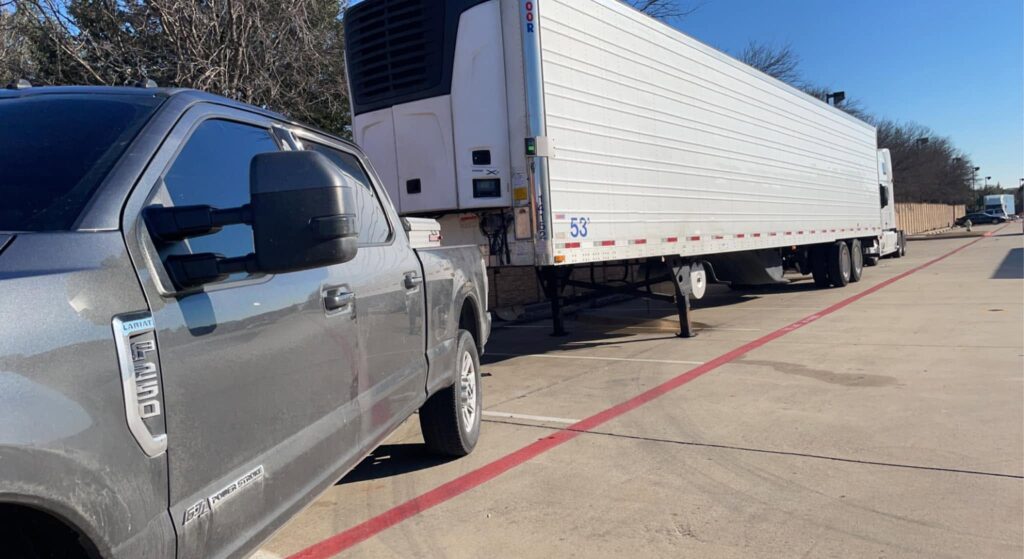
At Texas Reefer Solutions, we provide superior reefer service in Dallas, TX, covering produce, dairy, frozen goods, and pharmaceutical freight. We handle both major brands and get the repair done right at the trailer, no need to haul it in.
We start with the sensors on these units, because a controller reporting the wrong number kind of hides every other problem underneath it. So pull your last download and take a real look at what the box actually did.
What Counts as Temperature-Sensitive Freight
The category is actually wider than most people assume. Tolerance varies much more than cargo type alone suggests. Frozen goods hold at a low setpoint but can take small swings, since a few degrees either side of zero doesn’t spoil much of anything.
Fresh produce, on the other hand, sits in a narrow band just above freezing. Drop it three degrees, and you get chill injury, raise it three, and you’ve shaved days off the shelf life.
Dairy and prepared foods live in similar territory, with their own set of rules. Pharmaceutical freight is the strictest of the bunch, and it runs on documentation just as much as temperature. The load carries a specified range, an excursion limit, and a requirement to prove exactly what happened along the way.
A unit that recovered from a drift still technically failed if the record shows that drift ever happened. Getting pharmaceutical reefer service right from the start matters just as much as the mechanical side, since the paperwork is basically part of the cargo now.
Why a Sensitive Load Changes Service Priorities
On general freight, a service visit is mostly about preventing outright failure. The unit either works or it doesn’t, and the goal is keeping it in that first category. Sensitive freight adds a second standard, though, and that’s stability. Stability fails long before the unit itself does, so a trailer can pass every mechanical check and still lose the load anyway.
That shifts what actually gets tested. A run test matters more than a pressure reading, honestly, because the real question is whether the unit holds the setpoint through a full pulldown and hold.
Sensor calibration moves from a routine item to the headline item, and on a Carrier Transicold repair, that’s usually the very first thing we check. Airflow work becomes a priority too. A box with restricted circulation develops warm pockets that the return air sensor never even sees.
The Faults That Ruin a Load Without Stopping the Unit
The dangerous faults on this freight are the quiet ones. A unit that shuts down throws an alarm, and the driver knows within minutes. A unit holding the box two degrees warm, though, says nothing. The first sign of trouble ends up being a rejected delivery.
These are the faults we run into most often behind a temperature claim.
- Sensor drift, where the controller reports setpoint while the box actually sits outside it
- Slow refrigerant loss, which cuts capacity gradually instead of triggering a shutdown
- Blocked or damaged air chutes, which starve the far end of the trailer of cold air
- Door gasket wear, which creates a warm zone near the rear doors that the sensor rarely catches
- Defrost cycle faults, which ice the evaporator and cut airflow while the unit still reports normal operation
Loading practice sits underneath all of these faults, really. Pallets stacked against the front bulkhead, or packed clear up to the ceiling, block the air path the trailer was built around in the first place.
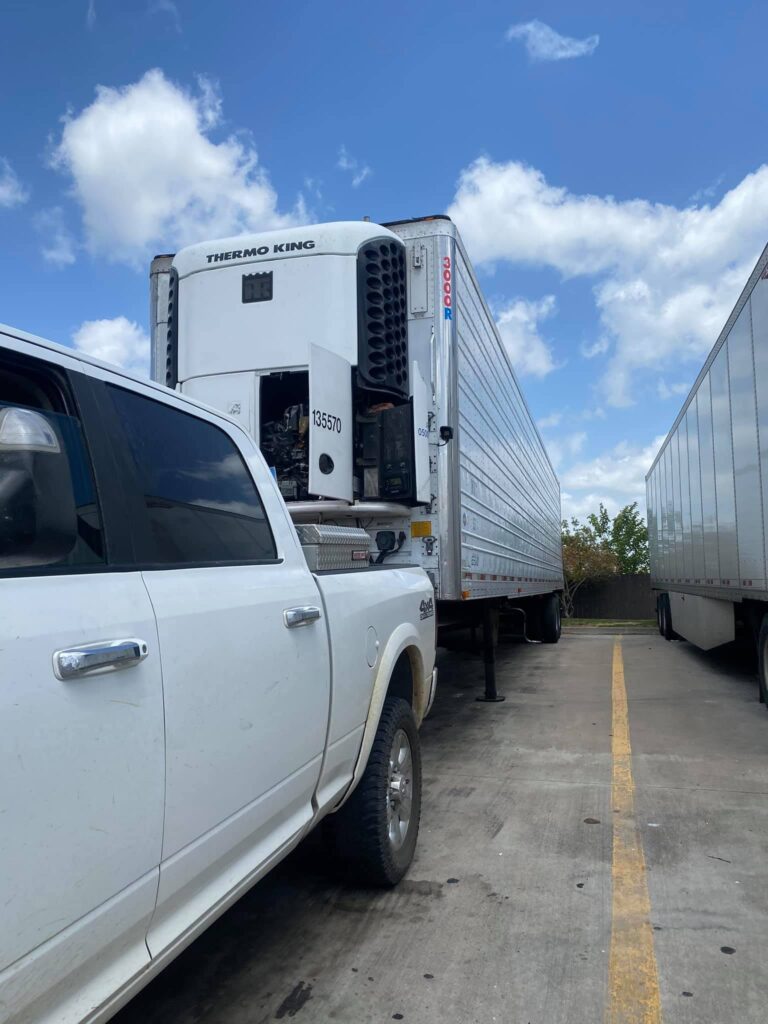
No amount of service work fixes a load that was built wrong to begin with. Drivers who leave the chute clear and keep product off the floor rails get a lot more out of a healthy unit, and that’s the quiet backbone of good refrigerated trailer service for produce and everything else riding behind it.
Freight that can’t afford to drift deserves a run test and a sensor check before it ever gets loaded, not after a claim shows up. Give us a call at (214) 791-3851, and we’ll get it scheduled this week.
Multi-Temp Trailers and Mixed Loads
Fleets running mixed freight often lean on multi-temperature trailers. These split the box into separate zones, each with its own evaporator and its own setpoint. The flexibility is real, and so, honestly, is the added complexity.
A multi-temp unit carries more sensors, more airflow paths, and more bulkhead hardware, and every one of those is just another thing that can quietly stop working.
Bulkhead seals deserve particular attention here. A bulkhead that no longer seals lets a frozen zone bleed right into a chilled zone. The result is frozen produce sitting on one side and a slowly warming frozen load on the other.
Both halves of the shipment end up failing from a single worn seal. We check zone separation during service on any trailer running mixed freight, every time. The controller and sensor side of these multi-temp systems gets just as much attention from us as the mechanical side does.
What Dallas Conditions Add to the Problem
Ambient heat is the obvious factor here, but it’s not the only one. A trailer loading produce at a Dallas dock in August is looking at a pulldown from well over 100 degrees. Every door opening during loading resets part of that work, too.
The unit reaches setpoint eventually, sure, but the product nearest the doors has already taken on heat it won’t give back. Precooling the trailer before loading changes this, and it really costs nothing but a bit of time.
Freight patterns matter here too. Produce moving up from the Rio Grande Valley arrives in Dallas already at the right temperature. It can’t afford a gap while a unit gets diagnosed, which is exactly why mobile repair matters more on this freight than it does on dry goods.
The same goes for loads staging through the distribution hubs south and east of Dallas, TX. That’s really the case for handling produce loads with mobile service, right out where the freight already sits, rather than waiting on a shop slot.
Proving the Load Stayed in Range
Receivers increasingly ask for data rather than assurance. The answer has to come from the unit itself. Modern controllers log box temperature continuously, and the download is the document that settles a dispute. A carrier who can produce a clean record has a short conversation. A carrier who can’t has a long one.
That record is only as good as the sensor behind it, which brings the question right back to calibration. Checking sensor accuracy at every service visit protects the paperwork as much as the cargo. It’s also a cheap item on a service sheet, when you think about it. For fleets hauling regulated freight, it separates a defensible record from an expensive argument.
Keep your temperature records clean by having sensors verified at every service interval, not just when a load goes wrong.
Got a load that can’t afford a diagnosis delay, or just want your sensors checked before the next run? Contact us at (214) 791-3851 or email justin@texasreefersolutions.com, and we’ll get you on the schedule.
Related Topics: